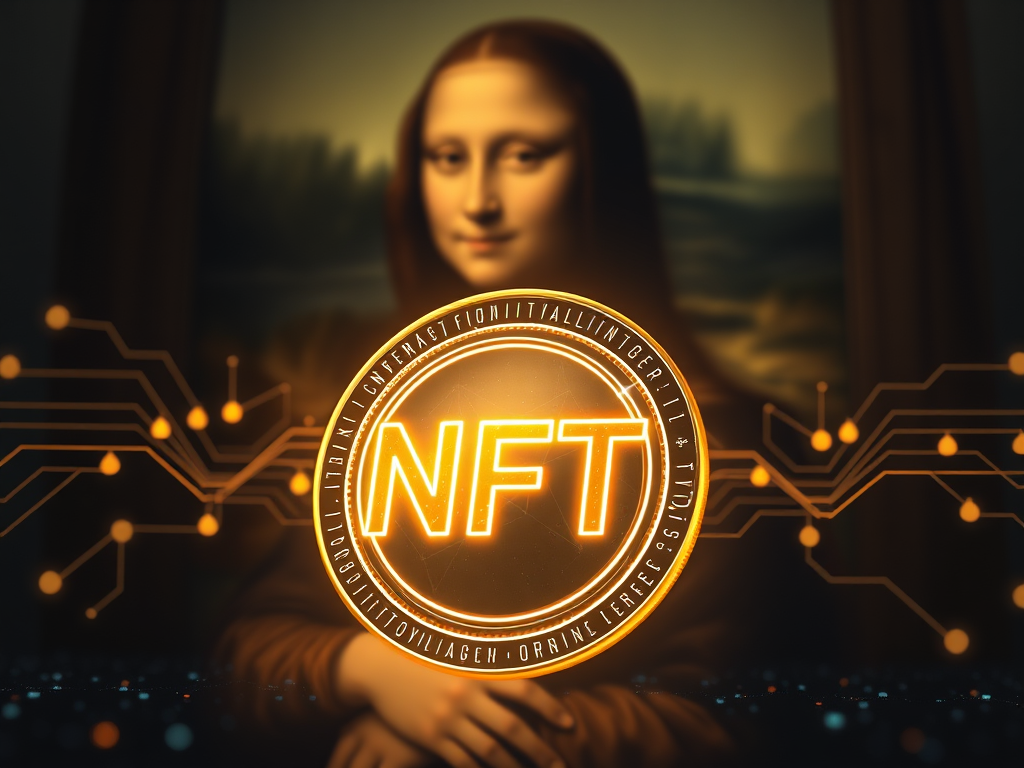
Are NFTs Just an Expensive “Emperor’s New Clothes”?
You’ve heard about NFTs.
You’ve seen the headlines—a pixelated avatar selling for millions, a celebrity launching a digital collectible. To most people, the NFT space looks like an incomprehensible bubble, a “scam” built around digital JPGs.
The most common criticism is: “Why would I pay for it? I can just right-click and save the image for free.”
If you’ve ever had that thought, congratulations—this article is for you. I’m going to use the simplest analogies to help you finally understand what an NFT is. Spoiler alert: It has never been about the picture. It’s about ownership.
Part 1: The “Aha!” Moment: Fungible vs. Non-Fungible
To understand NFT, you first must understand two simple economic terms:
- Fungible: Refers to items that are interchangeable and identical in value.
- Example: The $100 bill in my wallet is identical in value and function to the $100 bill in your wallet. We can swap them, and nothing changes. Bitcoin (BTC) is also fungible.
- Non-Fungible: Refers to items that are unique, indivisible, and irreplaceable.
- Example: The original Mona Lisa painting is non-fungible. There is only one. The deed to your house is non-fungible; it corresponds only to your specific property. A front-row ticket to a concert is non-fungible; it’s for one specific seat.
NFT stands for Non-Fungible Token.
Now, here is the single most important definition you need to remember:
An NFT is a digital certificate of ownership stored on a blockchain. It is a public, transparent, and unforgeable “digital deed” that proves you—and only you—own a specific asset (usually a digital one).
Part 2: Why “Right-Click, Save As” Is a Flawed Argument
Let’s go back to the “right-click, save” myth.
- The Analogy: You can go online, find a high-resolution image of the Mona Lisa, print it, and hang it on your wall. This does not mean you own the Mona Lisa. The original, verified painting hangs in the Louvre.
- The NFT’s Role: The NFT is the publicly verifiable “certificate,” protected by global consensus, that proves who owns the original.
- What you “save” is just a copy. What the NFT holder owns is the globally recognized proof of ownership.
Part 3: How Do NFTs Work? (The Simple Version)
You don’t need to be a coder. You just need to know these three concepts:
- Blockchain: Think of this as a global, shared, permanent public ledger (or giant spreadsheet) that no single person can alter. When you buy an NFT, this ledger is updated for the entire world to see, proving you are the new owner.
- Smart Contract: This is the “rulebook” built into the NFT’s certificate. It can automatically enforce rules, such as:
- Royalties: “Every time this art is re-sold in the future, the original artist automatically gets 5%.” (This is a revolutionary feature for creators).
- Attributes: “This NFT has ‘Laser Eyes’ and ‘Gold Fur’.”
- Minting: This is the act of “publishing” an NFT. It’s the process of taking your digital item (art, music, etc.) and its “rulebook” (the smart contract) and registering it onto the blockchain (“the global ledger”) for the very first time.
Part 4: Why Do NFTs Have Value? (It’s Not Just the Art)
If an NFT is just a “digital deed,” why is it valuable? Because this deed unlocks functions and possibilities that never existed before. This is the true value:
1. Digital Scarcity & Provable Ownership
Before NFTs, the digital world was a place of infinite copies (MP3s, JPGs). NFTs, for the first time, allow a digital item to be verifiably scarce, just like physical gold or a real-world collectible.
2. Status Symbol & Community Access (PFPs)
This was the first massive use case (e.g., CryptoPunks, Bored Ape Yacht Club – BAYC).
- PFP (Profile Picture): Owning a specific NFT avatar isn’t just about the art.
- Membership Card: It acts as a key to an exclusive club. Owning a BAYC NFT gets you into private Discord channels, exclusive parties, and access to future “airdrops”—it’s a form of social capital and identity.
3. Utility & Function (The Future)
This is where the real, long-term value of NFTs lies:
- In-Game Assets (GameFi): The sword, character skin, or plot of land you earn in a game is an NFT that you actually own, not the game company. You can sell it on an open market or (in the future) even use it in other games.
- Tickets & Proof of Attendance: A concert ticket as an NFT can’t be counterfeited. After the event, it becomes a permanent digital collectible proving you were there.
- Digital Identity (DID): An NFT can be used to represent your university degree, a professional license, or even your on-chain “credit score.”
Part 5: How Can an Average Person Get Involved? (A Practical Start)
Want to buy your first NFT? The process is simple:
Step 1: Get a “Wallet”
- This isn’t a physical wallet. It’s a browser extension or mobile app (like a digital bank account) that lets you manage your Web3 assets.
- Recommended: MetaMask (the “fox wallet”) or the OKX Web3 Wallet.
Step 2: Get “Ammo” (Cryptocurrency)
- NFTs are primarily bought and sold using cryptocurrencies like Ethereum (ETH) or Solana (SOL).
- You’ll need to go to an exchange (like OKX or Coinbase) to buy some ETH, which will be used to pay for the NFT and the “Gas Fee” (the network’s transaction fee).
Step 3: Go “Shopping” (NFT Marketplaces)
- This is where you browse, buy, and sell NFTs.
- Recommended: OpenSea (the largest and most comprehensive marketplace) or Blur (more for professional traders).
⚠️ Risk Warning: The NFT market is extremely volatile. 99% of projects may go to zero. Please only participate with money you are fully prepared to lose. Treat it as an educational experience or a hobby, not a guaranteed investment.
Conclusion: NFTs Aren’t the Destination; They Are the “Building Blocks” of Web3
An NFT is not a picture. An NFT is programmable ownership.
The “JPG hype” was just the very first, most basic application of this technology. Today, in 2025, NFTs are the fundamental building blocks for the next generation of the internet—from gaming and finance to social media and personal identity.
Now, when you see an NFT, you’ll understand: the art is just the cover; the real innovation is the unique, globally-verified, and infinitely programmable “deed of ownership” behind it.


Leave a Reply